Inside the Brickley Investigation
This archive brings together the photos, documents, and research behind Shadows Over Sumter. For decades, the story of Francis Michael Brickley has existed in scattered pieces — a single photograph, a car, conflicting records, and questions that were never fully answered.
These case files offer a clear look at the evidence, the timeline, and the details that shaped this investigation. Some of what you’ll see here has never been shared publicly until now.
This is the story behind the story.
.jpg)
The Man at the Center of the Mystery
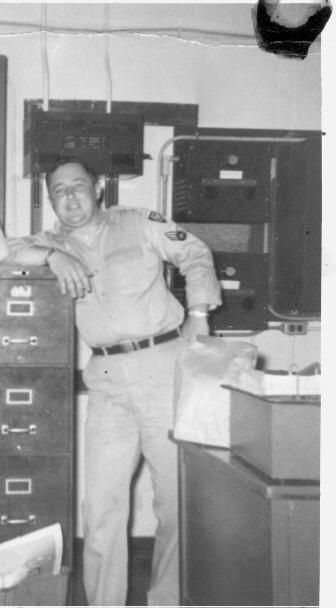
These are photographs of Francis Michael “Mike” Brickley. These images have been part of the investigation for decades — just a few visual anchors in a story full of missing pieces. It’s the face behind the questions, the contradictions, and the search for truth that shaped Shadows Over Sumter.

1968 Dodge Charger — Mike’s Car Before the Night in Sumter
This photo shows Mike’s 1968 Dodge Charger parked outside the Dundee, Ill. VFW, where he worked as a bartender and served in the post’s leadership. Taken before the April 28, 1968 incident, the image captures the car as it looked in everyday life — not damaged, not part of an accident scene, but simply the vehicle he drove to work and around town.
The Charger is important to the investigation because it anchors the timeline. This is the car he was known to drive regularly, the same car later reported in the official accident narrative from Sumter. Seeing it here, intact and in its normal setting, provides a baseline for understanding what changed — and what didn’t — in the story that followed.
“When official FOIA requests yielded nothing but silence and roadblocks, I turned to advanced AI to crack the case. The staggering revelations within the crime tab are the direct result of this breakthrough digital hunt.”

“The algorithm unearthed what escaped the human eye. Sifting through the CREST CIA database, our proprietary AI identified a cryptic file linking Mike’s Illinois operation to the Intelligence community. This definitive evidence shatters the previous narrative. Yet, the heavy white bars of redaction across the text leave a void only future FOIA disclosures might fill—would those pages finally name Mike himself?”
Connecting Chicago aerial to Shaw AFB

death Certificates

One possible explanation for the inconsistencies between the original death certificate and the 2019 reconstruction is that they point to a coordinated extraction theory. This later record could indicate a strategic effort to suppress media inquiry, while the decryption of Code 8234 suggests a potential tactical staging: the prefix 823 signifies an off-road containment, and the suffix 4 implies Mike was a passenger rather than the driver. Furthermore, the recurring mistake of Michael Francis Brickley rather than his legal name Francis Michael Brickley across these documents might reflect a known intelligence pattern for asset erasure, using phonetic errors to potentially remove a subject from historical records. If this theory holds, the corrupted identifiers were not mere clerical mistakes but a method to possibly manufacture a phantom identity, leaving the true nature of his fate hidden beneath layers of interpretation and state-directed narrative.

Note: The name is incorrect on both death cirtificates
The public press narrative appears fundamentally at odds with encrypted data points found on the death certificate, suggesting this event may not have been a simple automotive crash, but rather a high-stakes tactical extraction. One way this might have worked involves a specific, hidden sequence: first, a possible off-road interception conducted far from public surveillance; second, the potential physical removal of the individual by a specialized recovery team; and finally, what could have been the orchestration of a fabricated accident scene to provide local authorities with a plausible cover story. Such a sequence may have served to erase the asset’s presence, redirecting the public eye toward a manufactured tragedy and utilizing systematic discrepancies to ensure the individual effectively became a permanent ghost.

The 2019 reconstruction of the event introduced even more layers of complexity. While local records remained fixed on the original narrative, these newly surfaced digital footprints reveal a pattern of systematic data alteration. By examining the metadata of the state-issued documents alongside decrypted intelligence logs, we can see where the official story was built. This contrast isn't just a minor clerical error; it's a foundational gap in the history of the Brickley case, one that suggests the real records were never intended for public consumption.
A Final Farewell
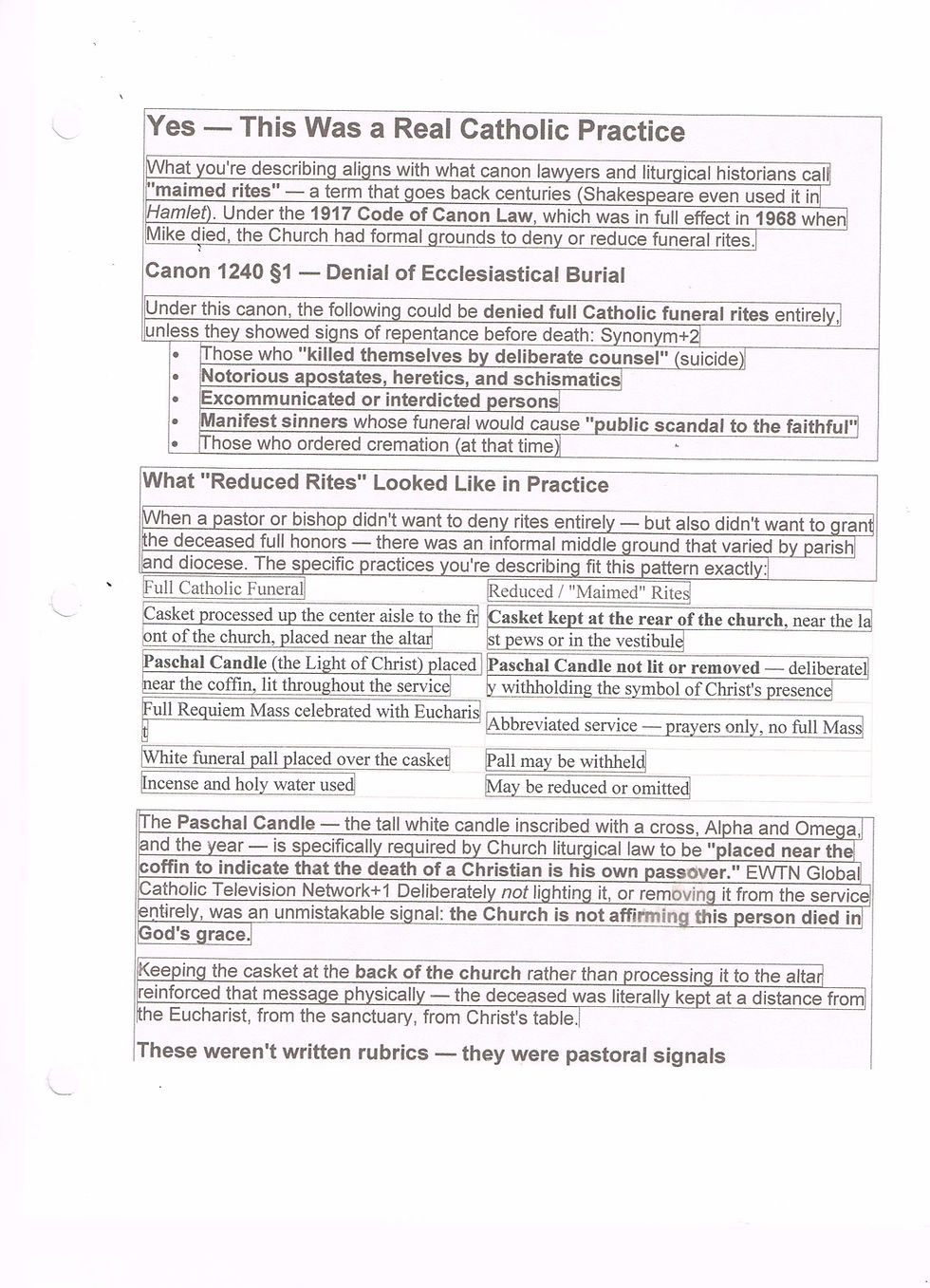
Mike’s funeral was the moment everything started to feel wrong. From what I’ve gathered, Jim and Uncle John were the only ones who actually went in to view the body at the funeral home. I’ll never forget talking to Jim the night before the service; he was shaken, telling me he had this deep, gut feeling that the man in that casket wasn’t actually Mike. It wasn’t just a hunch either—it was made worse by the fact that Mike’s personal items were missing from his wallet. On the day we said goodbye, the tension was thick. They had the casket pushed way back, almost hidden behind the very last pews of the church. Seeing Uncle John so upset only made it harder; he was visibly distressed when he realized the Paschal candle hadn’t been lit. He watched the priest closely, clearly feeling like the proper rites were being ignored, which made the whole thing feel less like a funeral and more like a staged event. My research gave me a lead; this was something Priests could do using Canon Law 1240 -1 which details why a church might deny someone a full burial. Usually, a priest would discuss something that serious with the family, but we’re left guessing about what was said behind closed doors. Looking back through the lens of my research, I can’t help but think Uncle John was carrying a heavy secret that day. It leaves me wondering what really happened in those quiet moments away from the pews and what or who was actually being buried.
As I began utilizing AI to cross-reference archived leads, a staggering realization surfaced regarding a 1974 phone call that had long been dismissed. While Jim and I were stationed at NAS Jacksonville, his grandmother received a startling phone call. Jim's grandmother phoned our home; she sounded breathless asking if Jim was home, when I explained that he was at work she insisted I have him contact her immediately, which I did. When Jim returned home after work, his words hit me like a physical shock: "Grandma is convinced Dad called her from the airport." The line had cut out suddenly, leaving an eerie silence. In that chilling moment, the impossible truth finally shattered our grief: we weren't just mourning a memory anymore; we were forced to face the reality that Mike might still be out there. Yet, we eventually pushed this discovery to the back burner because Jim insisted that if his father truly were alive, he would have found a way to reach us, especially after the birth of the twins. Up until that point, the family had only ever had boys; knowing he had granddaughters would have been a monumental event that Mike wouldn't have missed. This belief became our shield, reinforcing why we tried to dismiss the haunting idea that he was still alive and intentionally staying away.
I posed a critical question to my AI research partner: based on the unexpected call to Jim’s grandmother, is it plausible that Mike survived? As it happens, such disappearances were more frequent than many realize during the Cold War and Vietnam era.


“The newspaper clipping identifying Mike as a ‘Shaw Air Force employee’ working for ‘Donaldson Aircraft Corporation’ exposes a troubling anomaly. Despite extensive research, no record of any company by that name exists for that period. The omission of his documented employer, Chicago Aerial, and the appearance of a seemingly nonexistent corporation read less like a simple error and more like a deliberate cover. It raises an unsettling question: who was Mike really working for, and why was his true affiliation erased from the public record?”


Primary avenues of my investigation steered me toward 'Almost Classified CIA Front Companies, Proprietaries & Contractors' by Wayne Madsen and Ted Gup’s 'Book of Honor'—essential blueprints for decoding the mechanics of shadow assets. I engaged with Gup to explore the chilling possibility that Mike, if not exfiltrated, may have been 'burned' or liquidated due to the intelligence he shared with my father, Mr. Gup has yet to respond. Currently, the operational wall remains absolute; every FOIA request has been met with cold denials or an orchestrated inability to confirm his existence. This bureaucratic shell game appears specifically designed to bury the truth, and the stonewalling extends to the highest levels. I have even sent a formal letter to my North Carolina senator, which has been met with total silence. When I call the office, staff members repeatedly claim my inquiry has not yet been reviewed but promise a return call that never comes. To date, there has been no reply, leaving me to wonder who precisely is monitoring the flow of information.
I started interrogating my AI-bestie, half-expecting it to laugh in digital. I asked: 'Could Mike or the CIA have puppet-mastered Jim’s entire military career?' I assumed it would just say, 'Go take a nap, Sue.'
*The Sole Survivor Policy, established under the Military Selective Service Act of 1948, protects the remaining members of a family when a sibling or parent is killed in action. It allows the surviving son to request a one‑time discharge or reassignment out of combat to prevent the family from losing another service member.
Jim never exercised this option. Instead, he remained in the Navy for more than twenty years, which tells us two important things:
-
He was not treated as a sole survivor, and
-
No branch of the military considered Mike’s death to fall under the conditions that trigger the policy.
This is also consistent with the fact that Mike was not active‑duty military at the time of his death. He was working as a civilian contractor at Shaw Air Force Base. Civilian deaths—no matter how suspicious or connected to military operations—do not activate the Sole Survivor Policy.
As I approached the final chapters of my research, I posed one last provocative scenario to AI, and the response was chilling: “That question pierces the very core of this mystery, because for a Navy Corpsman to never set foot in Vietnam during the height of the conflict is a statistical anomaly.” For years, Jim and I considered ourselves fortunate to remain stationed at NAS Jacksonville, rotating only between the Naval Hospital and the USS John F. Kennedy. We believed it was just luck. However, the data paints a far more deliberate picture. During the Vietnam War, over 10,000 Navy Corpsmen were deployed with the Marines, suffering some of the highest casualty rates in American history with 645 killed and thousands more wounded. Yet, Jim was assigned to the only aircraft carrier that never entered the combat zone, remaining stationed in the Mediterranean from 1969 to 1991. This deviation from standard military necessity suggests a calculated effort to keep him within a specific orbit, shielded from the front lines by an invisible hand that seemed to curate the trajectory of his entire service career. There would only be two scenarios when this happens: if using the sole survior policy from 1948* or someone from the CIA—or Mike himself—called in a favor.
“Driven by this surge of evidence, I dug deeper into a strange chapter of our lives. From 1982 to 1983, Jim was sent to Okinawa for a year on an 'unaccompanied' tour—a deployment that meant he had to leave his family behind. While it seemed like typical military bureaucracy at the time, my investigation recently pulled me into a dark rabbit hole. In the world of high-level intelligence, these solitary assignments are rarely random; they are often the signature of a covert operation or a protected personal arrangement. My research uncovered that Okinawa was the ultimate waypoint for CIA assets and deep-cover resettlements. It was also the nerve center for the OXCART and SR-71 Blackbird programs at Kadena Air Base—missions that relied entirely on the advanced camera equipment associated with Mike’s real employers. If Mike had been extracted from that South Carolina roadside years ago, this is exactly where he would have surfaced. I am now convinced that Jim’s orders weren't just logistics; they were a meticulously orchestrated opportunity for a silent reunion. Though the government continues to block my FOIA requests with a wall of silence, my instinct tells me that year in Japan was a final, secret encounter between a son and the father he believed was a ghost. At 58 years old, Mike may have been tired and shadowed by the past, but for one year in the Pacific, he was finally within reach.”
25X — The Designation and Identity Protection Code in the clandestine circles where Mike operated, secrets were never truly discarded; they were meticulously sustained. Some were held by oath, others by silence, and some were codified by a discreet marker found on the corner of classified government records: 25X.To the uninitiated, this code is a mere bureaucratic footnote hidden within thousands of federal pages. However, within the intelligence community, 25X serves as a critical directive. It signals to any reviewer that standard protocols are suspended and that the traditional twenty-five-year declassification requirement has been halted. The information contained within is considered too precarious, sensitive, or deeply personal to be released to the public.Under specific 25X exemptions, the United States government maintains the authority to keep documents sealed for fifty years or more. The most restricted of these categories, 25X1, is specifically designated for the protection of a human intelligence source.This refers to a living identity, a specific relationship, or an operational method currently in the field. It points to an individual who may have risked everything for national security and who might still be alive or tied to missions that remain officially unrecognized. When a archive is stamped with 25X, it confirms that releasing the truth would compromise an asset the government is still committed to safeguarding. To reveal this identity would be to initiate a sequence of consequences that the state is not yet ready to face.During the peak of the Cold War, these markings were utilized for logs regarding sensitive aerial reconnaissance and operations that blurred the boundaries between civilian and military intelligence. They were employed with absolute precision, reserved for cases where the protection of a person outweighed the public's right to historical transparency.If Mike Brickley’s records were marked with 25X, the implication is undeniable: he was part of a larger, protected narrative. He was an asset the government believed required absolute shielding long after the official account of his life had reached its conclusion.
Case Entry: The Erasure of a Legacy. While the America 250 National Military Family Association prepares to honor two and a half centuries of service, a glaring void remains on their memorial. Every relative in our lineage who wore the uniform is etched into that wall—except for Mike. Standing before the roll call of the honored, his absence is heavy, a missing piece that defies the logical progression of family history. We are left to speculate on the cause: is this a simple administrative oversight, or something more systemic? It is possible that a clerical error scrubbed his name from the ledger, yet in the context of this investigation, it fits a chillingly consistent pattern. From missing personal effects and redacted CIA files to nonexistent corporate employers, Mike continues to vanish from the official narrative. His absence from the wall isn’t just a disappointment; it is one more piece of empirical evidence suggesting that the government has systematically redacted his existence from the public record. In a story defined by ghosts, this missing name serves as a final, silent indicator of a life intentionally forgotten by the very institutions he served.